


Saint Joseph: Silent Guardian of the Church
Description:
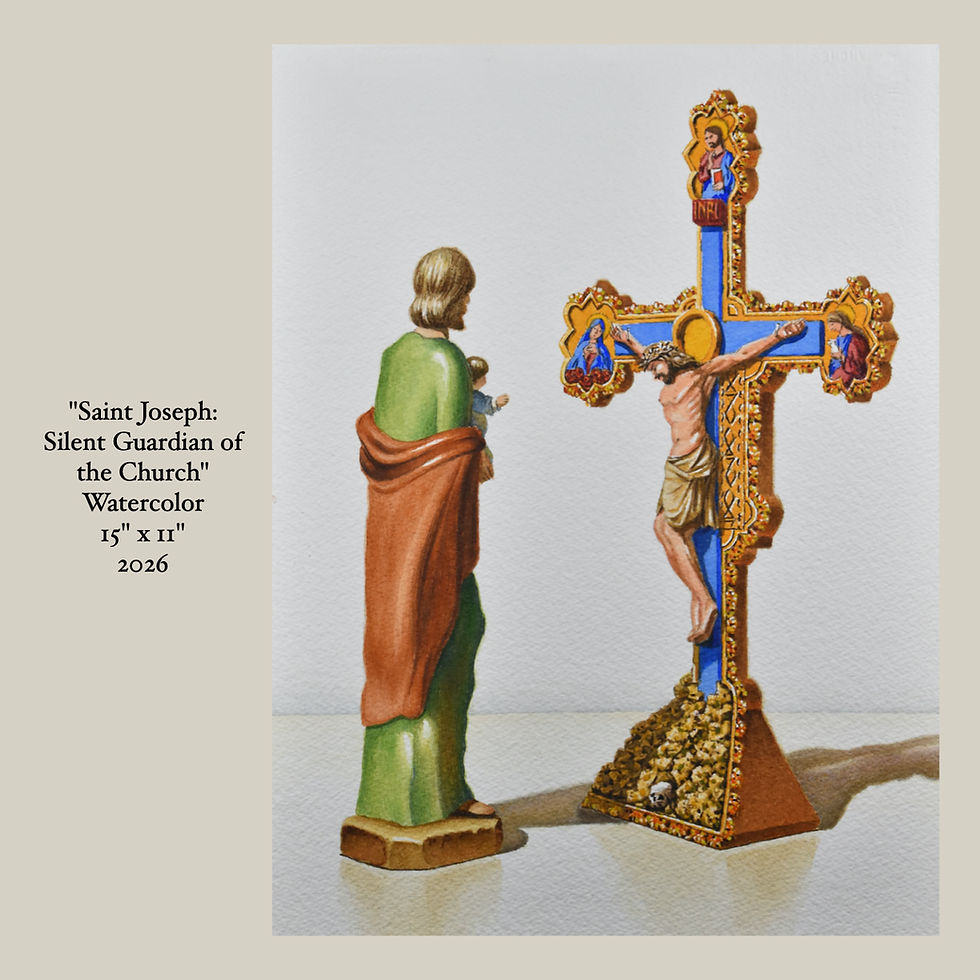
This watercolor shows two religious statues placed on a plain white surface. On the left, the viewer sees the back and side of Saint Joseph holding the infant Jesus. Joseph wears a green robe with a brown cloak. The child faces forward with arms stretched outward. On the right stands a detailed crucifix turned slightly toward Joseph. Jesus is shown crucified on a bright blue cross with gold trim. Small painted images decorate the cross: Mary with roses, Mary Magdalene with a jar, and Saint John holding a book and pen. A skull rests at the base of the cross, symbolizing Adam.
The composition creates a quiet visual conversation between the Child and the crucified Christ, linked by their similar arm positions. Strong light from the upper left casts long shadows and soft reflections on the white floor, adding depth. The colors are rich but controlled, with warm browns and golds balanced by cool blues and greens. Smooth brushwork and careful shading give the statues a realistic, solid form while keeping a calm, devotional mood.
Ed Cepiel
2026
Detailed Analysis:
Saint Joseph, the quiet father who stands between the child and the brutal reality of suffering and death. He cannot shield the child from what the child is destined to become. He’s the humble protector at the threshold between the human and the divine. Joseph and the Christ Child are standing to the left, the symbolic side of origin, hiddenness, and preparation. On the right is the crucifix, the side of manifestation: promise to fulfillment, seed to fruit, type to reality.
Joseph’s position as observer reflects the biblical theme of the righteous guardian of mystery, like Joseph of Egypt or the Old Testament patriarchs who stood at the edge of revelation without fully grasping it.
The Christ Child’s outstretched arms mirror the crucified body, collapsing time into a single psychological image. The prefiguration of death embedded within infancy. The mirroring arm gesture shows beginning and end, birth and death, innocence and sacrifice. The Child is the “small pattern” that contains the full reality in seed form. What is hidden in the Nativity is revealed in the Passion. The Incarnation and Redemption become one continuous reality.
The crucifix, detailed and frontal, represents the stark intrusion of mortality, pain, and sacrifice. St. Joseph is the father who foresees suffering but cannot intervene. The crucifix itself functions as the Axis Mundi, the sacred center of the world. Its vertical line connects heaven and earth; the horizontal connects humanity. The smaller figures, Mary the Mother, Magdalene the Penitent, and John the Scribe represent a symbolic “cloud of witnesses.”
The skull at the base reinforces death as an unavoidable foundation of human existence, a Memento Mori, a reminder of death rising from the unconscious awareness of mortality. It lies beneath the cross because transformation happens by confronting your cross and not denying it. The skull represents the old creation, Adam and the fallen world. The cross planted into it shows the new creation growing from the old. Death becomes soil for resurrection.
The empty white space surrounding the figures becomes symbolic unformed potential, like a field in which divine meaning appears.
The strong directional light suggests revelation, the movement of unconscious content into consciousness, fears and realizations emerging into awareness.
The Symbolic Meaning of Numbers
Though subtle, numbers quietly structure this image.
FOUR - The crucifix forms a four-part structure (top, bottom, left, right), evoking the number four, symbol of the created world: four directions, four winds, four corners of the earth. The crucifix is visually planted in creation itself.
THREE - There are three small figures on the cross (Mary, Magdalene, John). Three in Hebrew symbolism often conveys completeness and stability (like the three patriarchs). Here, they form a stable human witness to divine action.
TWO - We see two main sculptural forms — Joseph/Child and the Crucified — suggesting duality: life and death, beginning and end, hidden and revealed. In Hebrew thought, two also signals testimony (“by two witnesses…”). The Child testifies to the Cross; the Cross explains the Child.
ONE - The skull represents one humanity — Adam as the single origin of mankind. From the one comes the many.
FIVE - The cross shape itself can be read as five points (four directions plus center), a pattern sometimes associated with the structured wholeness of the world centered on divine presence.
CONCLUSION - Thus, numerically, the image moves from unity (Adam) to duality (Child and Crucified) to created totality (four directions) gathered around a sacred center.
The Symbolic Meaning of Colors
Color symbolism deepens the theological structure.
Blue on the cross recalls tekhelet, the sacred blue thread in Israelite garments, symbolizing heaven, divine command, and covenant faithfulness. The crucifix being blue visually declares it as the meeting place between heaven and earth.
Gold trim suggests glory, kingship, and divine radiance — qualities associated with the Temple and sacred objects.
Green on Saint Joseph connects to life, growth, and the earth — fitting for a carpenter and earthly father. He embodies grounded, nurturing life.
Brown (his cloak and the wooden base) speaks of humility, soil, and mortality — Joseph is of the earth, not the heavens.
Red details in the medallions evoke blood, sacrifice, and life-force. In ancient Israel, blood belonged to God; here it is visually tied to divine offering.
White background suggests purity, light, and uncreated space — similar to priestly garments and the idea of holiness as separation. The figures appear within a field of sacred stillness.
Together, the palette moves from earth tones (human life) to blue and gold (divine presence), visually narrating the union of heaven and earth.
Ed Cepiel
2026
Iconographic Analysis:
This work presents a theological image built from established Christian visual symbols, arranged to reveal meaning through relationship rather than narrative action.
Saint Joseph and the Christ Child
Joseph is shown from behind, which is unusual in devotional imagery. Iconographically, this removes individual identity and emphasizes role: he is the guardian and witness. He does not act; he beholds. His posture directs attention away from himself and toward the mystery before him.
The Christ Child’s outstretched arms deliberately echo the Crucified Christ. In Christian iconography this is called a prefiguration gesture — the Child already bears the form of His future sacrifice. Nativity and Crucifixion are shown as one continuous mystery: Incarnation exists for Redemption.
Joseph holding the Child while facing the Cross makes him an icon of the Church’s role: to present Christ to the world while contemplating His sacrifice.
The Crucifix as Theological Center
The crucifix dominates the composition and serves as the visual and theological axis. Its decorated structure resembles liturgical or medieval processional crosses, which are meant not only to depict Christ but to proclaim His kingship and glory even in suffering.
Christ’s body is naturalistic, emphasizing real human suffering, while the cross itself is ornate and radiant — a common iconographic contrast showing that the instrument of death has become the throne of victory.
The Figures on the Cross
Small medallion images expand the scene beyond Golgotha:
Mary (with roses) represents faithful sorrow and spiritual motherhood. Roses often symbolize love joined to suffering.
Mary Magdalene with a jar identifies her as the repentant sinner who washed Jesus’ feet with her tears. She was the first witness of the risen Christ. Her presence links Passion to Resurrection hope.
Saint John holding a book and pen identifies him as the Evangelist and theological witness. He represents the written testimony of what the cross means.
Together these figures form a traditional “witness group” found in crucifixion iconography: Mother, Penitent, and Beloved Disciple — love, repentance, and testimony.
The Skull at the Base
The skull beneath the cross is a very old symbol. Golgotha means “Place of the Skull,” and tradition held that Adam was buried there. Iconographically, this shows Christ’s sacrifice redeeming fallen humanity. The cross planted in Adam’s grave means the New Adam heals the first Adam’s sin.
Light and Space
The strong directional light is not just natural but symbolic. In icon tradition, light represents divine presence. Illumination from above left suggests grace entering history. The long shadow grounds the holy event in real time and space, holding together eternity and the present moment.
The white, empty background removes the scene from a specific location, which is typical of iconographic space. It creates a timeless, contemplative field rather than a narrative setting.
Overall Iconographic Meaning
The painting is not simply devotional still life; it is a theological statement in visual form:
The Child foreshadows the Cross
The Guardian contemplates the Sacrifice
The Witnesses surround the mystery
The Fall (Adam) lies beneath Redemption
The Cross stands at the center of creation and history
In iconographic terms, this is an image of silent contemplation of the Paschal Mystery — fitting perfectly with the title Saint Joseph: Silent Guardian of the Church.
Ed Cepiel
2026
Ode to St. Joseph
O Joseph,
quiet axis of the turning world,
you stood where thunder did not speak,
where heaven chose the grammar of silence.
Righteous man,
you carried justice like a steady breath,
not shouted in the square
but practiced in the dark—
in the long pause before judgment,
in mercy chosen without witnesses.
When the mystery entered your house
you did not seize it.
You stepped back,
remembering fire, remembering Uzzah,
remembering that holiness is not handled
but received with fear and love intertwined.
You knew the Ark once struck men dead,
and now the Ark slept under your roof,
living, breathing, veiled in flesh.
You loved Mary enough to leave her,
and loved God enough to let go of your name.
This was your first obedience:
to disappear so salvation would not.
Then the angel came
not with spectacle,
but with command sharpened by trust:
Do not fear.
Take her.
Guard the Child.
Remain.
And you remained.
You became the wall no sword could see,
the vigilance between the crib and the knife,
between the Child and the kings of fear.
While others dreamed of crowns,
you dreamed of bread, of shelter, of roads at night.
You taught the Word how to speak,
the Law how to walk,
God how to call a man father.
Son of David without a throne,
you ruled by staying.
By rising early.
By working wood straight
so the world might later be set right.
O Guardian of the Church unseen,
your strength was never loud enough to be praised,
only faithful enough to endure.
You did not die for the Gospel,
but you lived so it could live at all.
Teach us your courage—
the courage to obey without applause,
to trust when victory is promised but unseen,
to protect what is holy by refusing to possess it.
St. Joseph,
shadow of the Father,
pray for those who stand watch in silence,
for those whose holiness is hidden,
and for a Church that still lives
because you once said yes
and kept saying it
every ordinary day.
Ed Cepiel
2026


